•  

    grunge city

    The door is open a crack. Granted it is only a very small nearly imperceptible crack. This means the door is not locked. That which is beyond the door could push its way inward, inward into your thoughts. The door is the door to your mind. That which is outside, in this case, is Christianity.

    Over the years I have noticed that many atheists and agnostics will leave the door to their mind open, if only a crack, for Christianity. The door is never open to Zeus and his horde of Gods. The door to Odin and his son Thor has rusty hinges from lack of use. Yet, when Atheists or Agnostics allow there is that small chance God may exist, why is it always the God of the Bible?

    Maybe an Atheist or Agnostic in another country would leave the door open a crack for some other God. It could be that one leaves the door open to the God in your neighborhood.

    Knowing what we know in these enlightened times from gleaning information leftover after Christians, over the ages, worked so hard to destroy it, hide it, obscure it, why allow the door to Christianity open even a millimeter? We have more than sufficient information to prove that the New Testament was merely extrapolated from the Old Testament, sometimes word for word. The Old Testament itself has many plagiarized stories taken from older myths and legends. We know that Books were deleted and passages added. We know that the authors of the four most well known books of the Bible, the Gospels, were not who they were said to be.

    It simply makes no sense to leave the door open for the Christian God if the doors to others are locked tight. There is every bit as much information substantiating Zeus’ existence as Jesus’, maybe more. Odin and Thor are much more fun than the jealous and murderous God of the Bible. Odin said he would rid the world of Ice Giants. I haven’t seen any lately. God would see the end of evil, yet it still remains.

    If you must leave some door open a crack for some God, make it an unknown God. It is clear you cannot trust the Gods of man as man’s imagination is endless. No known God has presented itself or provided the means to identify and confirm its existence. Clearly, if there is a God, that God is unknown.

    All I am saying is that if for some reason you have to leave the door to your mind open to some God, even if just a crack, make that God one for which there is no evidence pointing to its fictitious origins. Then, once establishing this tiny crack, wait until such time as there is ample reason to open the door further. If you come to me with evidence of your new found God, it had better be good!

  • Many a Christian, engaged in a desperate attempt to save my soul, has claimed that when they surrendered to god to have had a supernatural experience. With the entrance of the spirit of god these people assert a cleansing of their soul. I respond, as is my nature, that it is all in their head.

    Many an observer has had their perceptions tainted by their proximity to the object observed. When we step back a bit and observe behavior from the perspective of a disinterested party, reality becomes clearer. From the advantage offered by a more distant window, the disinterested party can apply reason and common sense, and perhaps discern a better, a clearer, view of the truth.

    Christians claim a change. Do we in fact see evidence of this alteration? Is there evidence that this change is anything more than another façade erected to obscure the individual claimants true nature?

    Christians continue to:

    • lie
    • commit criminal acts
    • express hatred, jealousy, violence, bigotry

    Christians claim a high moral ground. They claim that all morality originates from their god. They claim that even though they be in this world , they are not of it. Nevertheless, from the vantage point of the impartial viewer, they exhibit no signs of being different, being more moral, of having undergone a miraculous change.

    From the overlooking, indifferent, observer observing the mass of what is called civilization, quite the opposite seems to be true. These Christians seem to exhibit much the same behavior as the preponderance of the population. Not only that, but they commit acts of immorality more frequently. When measured not by biblical, but modern human morality, Christians not only commit immoral acts more frequently, but also, while doing so, claim special privilege for doing so. The word of their god, the Bible, gives them special license, they claim, to express bigotry. They do not label it bigotry, society does. Society can go to hell, and will, by their standards. Violence committed in god’s name occurs, and has occurred, and is excused by these “loving” Christians, as righteous behavior. They make the old saying that “the winners write the history” starkly apparent.

    Humans engage in both moral and immoral acts. Christians and nonbelievers both do good, and bad, service to humanity. Motivations for these acts are of importance. The behavior of a Christian is encouraged by fear. They fear their god. They are promised that if they obey the dictates of their god they will receive the generous reward of immortality. This reward works to assuage their natural fear of death. Conversely, they are repeatedly admonished, that if they do not acquiesce to the will of their god, they will suffer an indescribable and hideous, everlasting death. It appears, to the dispassionate and disinterested observer, they do good in the act of seeking a reward, or in seeking to avoid punishment. It would seem neither a generous, nor a selfless act. Naturally, it is true that nonbelievers are not as likely to do good. Altruism has never been a natural trait. It is arguable that altruism does not exist. Yet, many nonbelievers have given great sums of money for the benefit of humans with which they have no acquaintance. Neither seeking immortality, unless you count in the memories of those they help, nor seeking to be absolved from some indescribable punishment, acts of kindness, generosity, frequently are engaged in by those who are not aligned with any faith whatsoever. Such selfless giving, in the eyes of the disinterested party, the non-aligned party, seem of a much higher order than any of those committed by those claiming faith in the divine.

    Observations from the precipice, the vantage point of the neutral observer, derive no evidence of divine guidance of the faithful from above. The behavior of the flocks of numerous religions compares to the general population in most respects, unfavorably in many other respects. If one were to claim the population of prisons as a measure of the morality of portions of the masses, the devout do not fare well. Yes, presently the percentage of the masses that claim divine guidance are a majority in the United States. Nevertheless, the portion of the prison population which the faithful comprise, is much greater still. This disparity cannot in whole be attributed to the proselytizing of the inmates, though religion is well known to feed relentlessly upon the down and out.

    In conclusion it can be asserted that:

    • All humans are capable of committing good or evil acts
    • Christians exhibit no evidence of divine guidance nor of change
    • If there are altruistic acts, nonbelievers come closer to accomplishing such acts than believers
    • Religions, though they may have served to make groups more cohesive in the past, are detrimental, divisive, and undesirable now

    What other conclusions can you derive?

  • Evolution

    In light of the many fables presented in the Bible pertinent to human origin it is my contention that the beliefs of Christianity are incompatible with the science of evolution. It is only recently that many of the religious have decided that the Biblical stories of human origin were metaphorical, meaning figurative or nonliteral. Throughout history the followers of Christianity believed the stories literally. The authors of the Bible took great pains to depict the ancestral lineage through the ages. It is clear that the Bible authors meant it to be a literal presentation.  

    Evolution has been denigrated by believers in many ways. From the present incomplete fossil record, to supposed irreducible complexities, to the Cambrian explosion, and even to the argument, irrelevant to science, that evolution demotes mankind to the level of an animal, the bombardment from the religious has proceeded nonstop. Nevertheless, evolution remains, despite some problems, the best scientific explanation for human origin.

    Religion

    Religions all have the same origin. As primitive humankind ventured about they saw forces at work which at  the time were unexplainable. They saw lightning, storms, earthquakes, volcanoes, and floods. They saw the abundance of the world and wondered from whence it came. The human mind, having been conditioned by events in their lives, decided that behind every force there had to be a cause. (Such reasoning kept them safe from predators) They saw the effects all around them. Effects, they decided, needed a cause. No one can say what God, or thing, they decided upon first as the cause—that  information being lost to the deep past. That was the beginning of belief. Since then, just as the first conjecture about cause, every religion springing from that point has found its origin within the fertile imagination of humankind.

    Evolution has a foundation of research and discovery to support its assertions. Christianity requires a foundation if it is to stand up to scrutiny. That foundation is the original sin. If Adam and Eve were metaphorical, as many modern theologians proclaim, meaning Adam and Eve did not exist, then the original sin as a foundation for Christianity vanishes. Science has proven these modern theologians correct. They have themselves undermined the foundation of Christianity. If Adam and Eve did not exist, then there is no original sin and no need for redemption through the human sacrifice of Jesus. The house of cards cannot stand without a foundation.

    Naturally one cannot expect the beast of Christianity to die so easily. It is, after all, a very lucrative scam. Having such a heavy investment in time, and considering the millions of dollars which are accrued each year, the belief of Christianity has much to lose. Instead of collapsing under its own absurdities, Christianity takes a step back. The modern theologians claim that the story of Adam and Eve is a symbolic representation for the fall of humanity into sin. This tendency to withdraw backwards into other comfortable niches is an on-going occurrence whenever science is used to examine some Biblical assertion. Just as the assertion that Satan arranged for dinosaur fossils in order to tempt humans into disbelief is an absurdity, so are these modern attempts to maintain illogical belief in unsubstantiated doctrine.

    This, along with many other incongruities in Christianity, like the lack of evidence for the existence for Moses or Jesus, point to the likelihood that the Bible, like many legends at the time, is simply a collection of folklore myths.

    God

    There is so much information, and lack of information, that indicates that the God of the Bible is no more real than Zeus, Odin, or the long line of Gods derived from human imagination, that  it can be safely concluded that the lot of them are fictitious. Does this leave room for a God, at least a God of some sort?

    There is no evidence of a God’s intervention in human affairs. A beseeching by humans for God’s intervention have proven no more reliable than those same humans imploring a rock to intervene and answer prayers. So what remains for a God? What criteria must a God meet in order to accommodate these guidelines:

    • It has to be a God that is unknown even to the human imagination
    • It knows nothing of humanity or is disinterested in humanity
    • It has never been observed
    • It cannot be omnipotent as we could detect that, there would be evidence of its influence in everything
    • It cannot be omniscient if it is unaware of us or our pleadings
    • It cannot be omnipresent as it would know of us and be detectable

    Without the qualities of omnipotence, omniscience, or omnipresence, can it be called a God, as defined by many religions?

    I conjecture, as I have stated in the past, that such a being, while perhaps possessing some of the qualities of a God, did not create us, does not know of us, and certainly never intervenes in any human affairs. Most likely this being did not create the universe and is most likely a product of it, as we are. At this point such a creature is also a product of our imagination and is no more real than leprechauns, unicorns, dragons, or Tinkerbell.

    Conclusion

    In the meantime I think it is safe to presume there are no gods of any type. Until such time as science discovers one, we should relax, stop worrying about meeting some entity’s needs or wants, and focus instead on our needs and wants. Knowing this is the only life we will ever have should prompt us to live it well, and upon our deaths leave remaining humanity with good memories of our lives. Our efforts should be the perpetuation of humanity, the protection of humanity; meaning we should reach out to the stars and find additional homes for humanity. As it stands now, one good hit by a sizeable asteroid, one big blast from a super volcano, one humongous war, or even humanity’s destruction by some heretofore unknown biological contagion, and all of our history, our discoveries and accomplishments, will disappear as if they never occurred at all.

    There is much work to be done but first we must accept the challenge. The immediate challenges include population growth control, environmental preservation, and quality of life improvement for everyone. Outmoded philosophical and religious stances standing in the way of engaging this challenge must be abandoned. Future challenges include finding humanity new homes even if it means sending ship-loads of humans out into space with uncertainty, without knowing what they will find at journey’s end. 

  • Have you, as an atheist, ever been subjected to Pascal’s wager? Any non-believer that has debated, or simply argued points with a believer, will sooner or later, be told that it is better to wager that god exists, covering the bases so to speak, than wager god does not exist, and face the horrid consequences after death.

    It is easy to see at the outset that such a premise is flawed. If you are a non-believing atheist that requires evidence for belief, are you supposed to pretend? If your stance as an atheist is wrong and you end up standing before the pearly gates for judgment, won’t an all-knowing god know you are pretending?

    Our consciousness, our self-awareness, our uniqueness, all these plus a measure of ego, make us envision ourselves as possessing something more than the physical body. We come to think of ourselves as composed of a body, and then what makes up the difference.  Theists imagine the something other than body as being a soul. Some think of the extra as being a consciousness that prevails after death and may or may not arise to a higher plane.

    As an atheist, and I speak only for myself, I fully accept that the consciousness I experience is a product of biological processes. I expect that one day all my thoughts will be silenced and I will cease to be. Is this what I desire? Of course not, but it’s obviously what I am going to get. I would much rather be immortal, yet, on the other hand I do not fear being dead.

    Shortly after my father’s death I experienced a dream wherein he said to me “I don’t mind dying, I just don’t like getting hurt doing it.” Knowing my father fairly well, my mind was able to generate this dream which seemed to coincide with my father’s odd sense of humor. I always took it as meaning that, he didn’t mind dying, it was just the painful lingering he dreaded. I feel the same way and this is why I have always supported euthanasia. As a society we don’t treat dogs nearly as inhumanely as we treat humans.

    I really don’t think that anyone will receive a surprise after death. Not even the religious will experience the surprise of being right or wrong. Atheists will not be surprised, and theists will not be surprised, as they will simply have no consciousness with which to experience surprise.

    Human beings, with their egos, try to separate themselves… desperately try to separate themselves, from the “lower” animals around them. Death, the great equalizer, will have none of it.

  • Chugging right along, and gaining speed, an unstoppable juggernaut races toward certain oblivion. The brakes don’t seem to work. No effort seems to be made to apply them. Everyone appears to be running around with their hands in the air. Are they shrugging? Are they expressing bewilderment? Are they simply apathetic?

    The weight of this locomotive, barreling along at ever increasing speeds, tests the strength of its supports. Many on the juggernaut have expressed the concern that the thing is moving overly rapid. Numerous experts aboard have suggested that the brakes be applied before disaster appears. Some have given up, expressing the thought that perhaps the inertia is too great and it is too late. This may be the case.

    The majority simply pooh pooh the danger. They claim that no matter the weight of the goliath, no matter the speed, everything will be alright. With righteousness they proceed to multiply the weight of the vehicle, it travels ever faster. These people, this majority, not only pooh pooh all efforts to slow the great beast, they are angry at any who propose to do so.

    The enormous mass lumbers on, for how long no one can say. The tracks have broken, the load continues on, without direction.

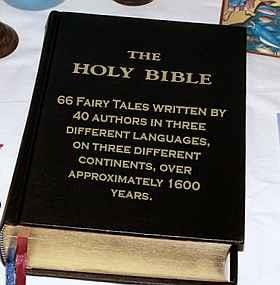
  • Many a believer in the religion of Christianity has asserted that the Bible cannot be understood by the heathen at large. They claim that you must be in the spirit to be able to grasp the word of God. The purpose of this post is to portray the ignorance of anyone who asserts that the Bible can only be understood while “in the spirit”.

    bible not so holy

    In the spirit”? What does that mean? On the website got Questions?org I found the following answer:Walking in the spirit

    Believers have the Spirit of Christ, the hope of glory within them (Colossians 1:27). Those who walk in the Spirit will show forth daily, moment-by-moment holiness. This is brought about by consciously choosing by faith to rely on the Holy Spirit to guide in thought, word, and deed (Romans 6:11-14). Failure to rely on the Holy Spirit’s guidance will result in a believer not living up to the calling and standing that salvation provides (John 3:3; Ephesians 4:1; Philippians 1:27). We can know that we are walking in the Spirit if our lives are showing forth the fruit of the Spirit which is love, joy, peace, patience, kindness, goodness, faithfulness, gentleness, and self-control (Galatians 5:22,23). Being filled (walking) with the Spirit is the same as allowing the word of Christ (the Bible) to richly dwell in us (Colossians 3:16).

    It seems to me that to “walk in the spirit” implies that you must believe. If to “walk in the spirit” in order to understand the Bible is a necessity, what the believer is asserting is that you must believe to understand. After you reach the point of believing one assumes that you must already understand. How did you reach the point of belief without first having understanding? If you are seeking understanding in order to believe, according to the believer you have no hope of reaching your goal. You must believe, they insist, in order to understand. “Accept by faith” is sometimes the response I receive when I insist that they are delusional. Are they imploring you to accept something regardless of the fact that you do not understand it and instead recognize it as irrational?

    What does it mean to “Accept by Faith”? Some say it is not faith without proof, but instead “trust without reservation.” Christians are very good at trying to change something into that which it is not, or changing something so it is obfuscated to the point of impossible discernment. In essence though, even “trust without reservation” is an advocation to throw yourself into belief without regard to reason. You must believe without reservation, without regard to reason, without thought. You must believe to believe. Do you trust everyone even if you do not understand or accept their motives?

    So, what does it really mean, to those who choose to believe without reservation or “believe to believe”? It means accepting a set of doctrine without examining, without subjecting it to reason, and without question. Does it lead to enlightenment? Does it lead to understanding? It leads to vulnerability, and gullibility.

    By insisting that you believe on faith without examining that faith with reason or logic Christianity is in effect transforming your mind into a moldable product, a clay, so to speak. Once successful in obtaining acquiescence for one or two absurd claims then acquiescence to even more outrageous claims will surely follow. Christians separate these thoughts by compartmentalization. While your logical mind will still function in the real world, that part of your mind belonging to belief will be tightly protected against any and all logical examination.

    Such pseudo-transformations are even easier if the victim is under stress from many of life’s challenges. Like a predator that feeds on the weak it perceives in the herd, religion preys on the most vulnerable.

  • Of late my site here has been hit by numerous messages containing multiple links. I presume these are entrepreneurs attempting to gain audience for whatever it is they are selling. Whenever I see them in my spam box I quickly delete them. I admit I don’t know how this works for them. Does it spread? Does it cascade through my readers? I haven’t received any feedback in days from readers, so something must be going on. Anyone with insight on this?

  • Although I prefer not to dwell on the past, I find that I often do. Our memories are not perfect pictures of moments in time as they fade with the passage. Yet, they are there, remnants picked up and then embellished with our own particular perception.

    Time, an invention of the human mind, may not exist at all. Something is working though, causing changes as it seems to progress. We see our bodies race towards decay, we see the seasons come and go. What can it be that we can label that presents these images to our senses, but time.

    Is time like a river? Does it flow? Is it an expansion, like a bubble? No one knows. Is there really a past to which one can travel? If everything is here now, what is left in the past?

    Perhaps the past is not really the past. Perhaps what we call the past is another reality racing behind us. To go back in time in this event would mean traveling between dimensions into someone else’s reality. The future? If we are not the first there would surely be previous realities ahead of us. Is all of this speculation merely in our heads? Surely, but who else is there to think it.

    Einstein spoke of differences in time passage. If a craft were traveling at near the speed of light, he proposed, time would slow for the occupants. They would return home to find much more time had passed than had passed for them. Depending upon the length and speed of the trip they might find upon their return that everyone they ever knew had perished.

    Many have suggested that travel into the past might be possible, but that travel into the future might not be. How they can know this I haven’t a clue. I would be more inclined to think there is nothing left behind, that is, if time exists. If otherwise, the requirements would be too immense. Having each second holding a different version of what we know as reality, each caught up in a moment, would require duplication of matter on an unimaginable scale. I admit this seems too much in the way of practical thought. If this were the case, where would each moment be divided in time. Would it be a second? A nanosecond? The more divisions, the more matter required. Are we then slipping through different dimensions, different realities, which we have mistaken as time? Is everything that ever was, and everything that will ever be, and of course everything that is, simply layers on some onion-like exploding orb?

    I can see only the now. We see vast galaxies in the distance as their distant light reaches us. We see them as they were millions, perhaps billions, of years ago. Yet, I can only think that even though all we see is past light, on distant worlds their instant in time is the same as mine. Now is now.

    On one hand I would like to have the answers. On the other, I would have the mystery remain. Science may solve these problems someday, if anything can. Will the answers be to our liking?

  • 100_1521d

    Suppose I told you the little fellow above has special powers? Well, he sure does! He can control the weather! Now, I have to admit that that is a large pill to swallow, and it will go down hard, but, the facts are the facts. Being small, his powers are a little limited. Some storms seem just a mite too strong or bullheaded for him to avert. That being said, he’s brought a lot of sunshine where rain might have fallen.

    Of course I know there will be some who will doubt. If the sunny day doesn’t happen as requested though, it’s probably due to the storm being too strong for the little fellow. Just the other day I requested a nice day so I could ride my cycle one last time before putting it on life support, and, sure enough, Sunday was sunny and mild right in November. Can you imagine?

    Sometimes the little guy doesn’t feel like working his stuff so it doesn’t pay to ask. I assume he’s not being mean but merely wants me to wait till later. Other times he just wants different weather than I do, and then, well, he’s got the powers, I don’t.

    You know what’s really hard to understand? I have the same problem trying to convince Christians that he’s the real McCoy as I do other folk. They believe in their God and he doesn’t always perform as they desire either, but nevertheless, they keep on believing, but not in the little guy that does such wonders with the weather, no… They tell me their God hears their prayers and answers them. Most of the time what they want to happen doesn’t happen. They don’t stop believing, no, they say it wasn’t his will or that God didn’t want to do it right then. Shoot, that’s what I say about the little guy. You ought to hear them when something goes their way though, such hollering you never heard.

    I’ve been told I’m crazy, that no cat, even an adult cat has powers. I say prove it. Till you do I’m telling you it works. You’re just jealous cause your cat can’t do it.

  • Many a theist claims that morality originated, emanates, from religion. My claim, and my claim is shared by many individuals, including many doing work with primates, is that morality came before religion. Religion came along and co-opted pre-existing moral perceptions.

    Christianity’s claim to be the originator of morality is laughable in any case as many of those moralities touted within the pages of its guiding tome are hardly moral. Who today would advocate stoning a disobedient child? Islam maybe. Christianity dictates that it must be done. Heretics must be killed. Non-believers must be killed. People who work on the Sabbath must be killed. Should I mention slaves? Jesus proclaimed that you have to hate your family to follow as one of his disciples. How moral is that?

    Evidence in prehistoric humans has been found that they cared for sick and injured individuals. In particular a male skeleton was found that exhibited a jaw without teeth. Evidence indicated that the individual had lived for many a year in this condition. The only way this individual could have continued is to have had others pre-chew food for him. (yuck) Other debilitating injuries were found in the bones as well. These injuries having shown signs of healing indicate that despite debilitating injuries, these individuals were able to continue, some for many years. The only way they could do so is if someone cared enough about them to help them.

    Some investigators speculate that not only did religion not create morality, most likely, religion is a by-product of human moral reasoning.

    There are many Christians that claim that without God there would be no moral reasoning. They claim that there was no morality before God’s Law. However, there is no evidence to support that fable. As a highly social species we have been using social structures like family, clan, and tribe at least 500,000 years.

    Writes John Shook of the Center For Inquiry:

    “Marc Hauser, professor of evolutionary biology at Harvard University, has just published a paper about additional studies showing that people’s moral intuitions do not vary much across different religions all around the world. From an evolutionary perspective, that means that human morality is very old — old enough to pre-date any religion that exists today. Furthermore, basic morality is highly resistant to religious influence — most people easily reject religious rules that violate their basic moral intuitions. Rather, religions all tend to confirm and support human morality, because that essential morality sustains our schemes of social cooperation.”

    Another source points out what is obviously missing. No other primates have religion, only humans. Yet, many of these other primate species form cohesive groups. If these apes did not share compassion and look out for one another there numbers would surely suffer. By working together these animals increase their odds for survival.

    Professor Frans B.M. de Waal, a Dutch/American behavioral biologist asserts that empathy comes naturally to a great number of animals.

    http://content.usatoday.com/communities/sciencefair/post/2010/02/620010081/1#.UPiUyfLheSo

    http://www.centerforinquiry.net/blogs/entry/morality_evolved_first_long_before_religion/

    http://oso.stanford.edu/lectures/125-morality-before-religion-empathy-fairness-and-prosocial

    ev·i·dence

    [ev-i-duh ns] Show IPA noun, verb, ev·i·denced, ev·i·denc·ing.

    noun

    1.that which tends to prove or disprove something; ground for belief; proof.

    2.something that makes plain or clear; an indication or sign

    What evidence would prove something to anyone without a doubt if what that evidence was trying to prove was in the deep past. We have evidence for evolution, fossils, which are substantial evidence in support of evolution. Scientists who study these fossils are convinced of evolutions reality, at least, the overwhelming majority of scientists. When genetic evidence came along to provide additional support, it was just icing on an already well substantiated cake.

    We can look at bones from the distant past and infer from their structures that individuals had issues with injuries and such. I am sure that bones that healed in humanity’s past, healed in the same ways they do now. I am sure that infirmities encumbered the suffering back then as those that suffer today. 

    We can observe those who so closely resemble human beings, the other apes, and deduce from their behavior that we most likely originated in similar fashions. If we do not deny our genetic links, our relation to these present apes, then we must concede that, like them, even when our consciousness was in midst of rising in the deep past, we must have cared for one another.

    It is clear to me that religions role in morality is much the same as that effort made by a society’s laws: to set rules of behavior for the members of the social group. It is clear that morality existed long before religion, and religion simply grew to be as yet another arrangement and refinement of already existing moral laws.